

Vi
En
HRM

Master of Human Resource Management (HRM)

Introduction

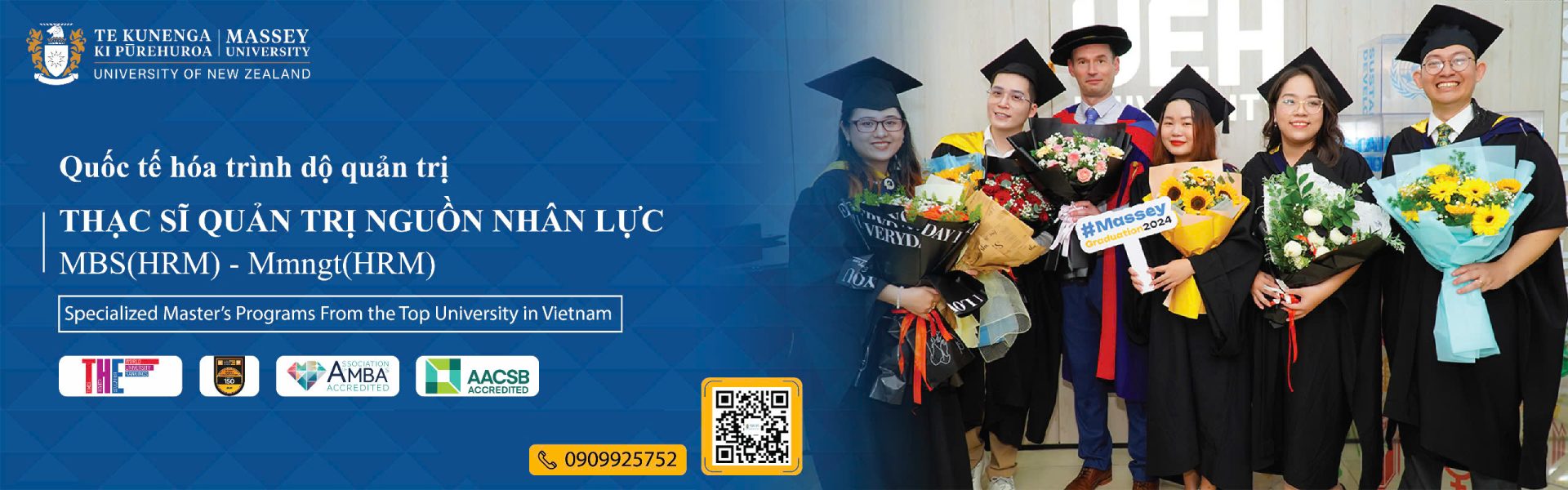
In New Zealand — a country that values sustainability, people, and diversity — the HRM function is positioned as a leading pillar of business. With the ambition to elevate the standing of HRM in Vietnam to its rightful strategic level, Massey University and the University of Economics Ho Chi Minh City (UEH) offer a Master’s program in Human Resource Management.

The Master’s in Human Resource Management includes courses that equip learners with knowledge of organizational behavior and employee behavior, enabling them to design and lead organizations through new development cycles aligned with sustainable trends that harmonize human development with effective technology application.

Participate in the Master of HRM program to gain specialized skills and knowledge in human resource management, empowering you to become an HR expert and contribute to your organization’s growth.

Why Choose HRM?

01. Key Pain Points in Human Resource Management (HRM) in the 2020s

The Reskilling Crisis According to the World Economic Forum (WEF), 44% of core workforce skills are expected to change within the next five years. Human Resources departments are rapidly shifting from a traditional focus on recruitment toward building and reskilling the workforce to adapt to emerging technologies.
(Source: WEF – Báo cáo Tương lai Việc làm 2023 (Future of Jobs Report 2023))

The Sudden Rise of AI (The AI Disruption) The International Monetary Fund (IMF) warns that AI will affect nearly 40% of jobs worldwide. One of the greatest challenges for HRM is determining how to integrate AI ethically, manage organizational change, and elevate human roles rather than simply replacing them—thereby preventing a deepening of global inequality.
(Source IMF Blog – “AI Will Transform the Global Economy” (tháng 1, 2024))

The Decent Work Deficit The International Labour Organization (ILO) highlights that, while unemployment rates may appear stable, productivity stagnation and the “decent work deficit” (poor job quality, low wages, lack of social protection) are reaching alarming levels. This situation leads to burnout, decreased engagement, and calls for HRM to redesign the Employee Experience.
(Source: ILO – Báo cáo Triển vọng Việc làm & Xã hội Thế giới 2024 (World Employment and Social Outlook: Trends 2024))

The DEI Imperative A report from the International Labour Organization (ILO) reveals that one in four employees feels undervalued in the workplace, particularly among minority groups. Businesses are losing productivity and innovation due to their failure to foster an inclusive culture. Modern HRM must lead the Diversity, Equity, and Inclusion (DEI) strategy as a core business pillar, rather than as a mere “check-the-box” activity. (Source: ILO – “Transforming enterprises through diversity and inclusion” (2022))

02. What do the Big Names say?

“Culture eats strategy for breakfast.” — Peter Drucker, the father of modern management.

“HR is not about HR. HR begins and ends with the business.” — Dave Ulrich

“Management is the art of getting things done through people.” Pioneer in organizational theory and behavior.

03. What direction will the Human Resource Management field take?

  • Business & Strategy Mindset HR professionals must not only read and implement strategies but also shape strategies from the human aspect and reorganize the company to create a competitive advantage. Only in this way can HR professionals play a role in the key pillars of the organization’s development.

  • Sustainability & Social Governance (ESG & Sustainability) HR professionals must understand sustainable business models to become key players in implementing most of the social (S – Social) factors within the context of sustainable development. Additionally, HRM will be a primary resource to support Senior Management in changing the mindset of all employees, fostering a culture that enhances the Planet (E – Environment) and Profit (G – Governance) elements of the organization.

  • Understanding Organizational Psychology & Behavior HR professionals must not only manage people based on numbers but must also master the competencies of working with individuals to help employees balance their complex lives and foster personal and team development. These are often unseen tasks within organizations but are crucial in determining whether HR professionals truly become the bridge between the organization and its people.
  • Data Analytics & Decision Making HR professionals should not only manage people using management tools and communication skills, but also move towards establishing data systems and analyzing human data to help the organization forecast and “prescribe” people-related issues. This is especially important in an AI-driven environment that increasingly disrupts the business system’s status quo.

– The first international program in Human Resource Management, conferred by Massey University, New Zealand.

– The program focuses exclusively on Human Resource Management as its core discipline.

– Students are trained in high-level professional competencies in English, following international standards.

– The program equips students with the capability to work effectively in international organizations, enterprises, and projects that require expertise in people management and HR leadership.

50% of the faculty are Human Resource Management professors from Massey University.

– The degree is internationally accredited.

– Graduates can pursue teaching positions at universities or continue their PhD studies abroad.

– The program offers two study options:
Master of Business Studies (Human Resource Management) – Students complete the first year at UEH – Vietnam and the final year at Massey University – New Zealand.
Master of Management (Human Resource Management) – Students complete the entire two-year program at UEH – Vietnam.

Our student community

LUNCH & CONNECT literally means “Lunch to Connect”, a weekly event held every Wednesday. It aims to provide attendees with opportunities to network, expand their professional connections, and engage in discussions on the latest trends and updates in the Management – Human Resources sector.

  • Eligible Applicants:

– Graduates from accredited universities in Vietnam and abroad.

– Applicants with a prior degree in Management or at least two years of work experience in Human Resources or Management.

  • English Proficiency Requirements:

– An international English certificate equivalent to IELTS (Academic) 6.5, or

– Applicants who do not meet the required academic background or English proficiency may enroll in preparatory programs.

– Applicants holding a bachelor’s degree in English Studies or English Language (both full-time and part-time programs) may be considered for an IELTS waiver for the first year.

  • Application Period:

April and October every year.

Program Structure

Brief program description

Philosophy for this course

  • The core philosophy of this course is that business is fundamentally about solving problems one after another. Success depends on an organization’s ability to recognize and prepare the capabilities to solve these continuous challenges.
  • The course is designed to equip students to explore new problems through the dual lenses of management theory and structured problem-solving steps.

What make this course special

  • Always update new problems: The curriculum is kept current by integrating the latest and most relevant business challenges and disruptions facing industries today.
  • Case study learning to enhance problem-solving capability: Learning is heavily focused on real-world case studies to provide hands-on practice in applying management theories and problem-solving frameworks in complex, realistic scenarios.

Philosophy for this course

  • The foundational belief of this course is that Human Resource Management is not just about practice or tools; it is, fundamentally, a mindset behind every organization’s success.
  • HRM is Mindset-Driven: The focus is on developing the underlying strategic thinking and philosophy necessary to effectively manage people, rather than simply mastering administrative procedures.
  • Continuous Design and Improvement: The course emphasizes that there is no one right human resource management system. Effective HRM must be constantly designed and improved continuously to align with the organization’s evolving strategy, culture, and external environment.

What make this course special

  • Story-Based Learning: Moving beyond book knowledge, the course uses daily HRM stories and real-world examples to help students better understand the necessary mindset and model for effective people management.
  • Systemize the Whole Knowledge Base for Big Picture: The curriculum is structured to help students connect the dots between different HRM functions (e.g., recruitment, training, compensation) to grasp the “big picture” and understand how each component contributes to the overall strategic goals.

Philosophy for this course

  • The philosophy of this course is rooted in the urgent reality that climate change is everyone’s responsibility. While Vietnam has committed to achieving Net Zero emissions, a fundamental challenge remains: sustainability does not always align with traditional business goals.
  • This necessitates a profound shift. Businesses must rethink and redesign their business models to ensure they are inherently sustainable. Achieving this requires sustainable thinking from all positions within the organization. Crucially, Human Resources (HR) plays a pivotal and transformative role in driving this enterprise-wide change.

What make this course special

  • Role of Business in Sustainability: Understanding the corporate mandate and strategic imperative for addressing climate change and societal impact.
  • Business Model to Support Sustainability: Learning how to innovate and re-engineer current business models to embed environmental and social sustainability as a core value driver.
  • HR Role in Sustainability: Detailed exploration of how HR functions—from talent acquisition and training to culture and compensation—can lead the transformation, build a sustainable workforce, and ensure the organization meets its Net Zero commitments.

Philosophy for this course

  • All forms of business are undergoing continuous and rigorous evolution. The small differences between those who had to stop their journey and those who move on is their ability to ask the right questions and their ability to solve those questions.
  • Most of the time, we use our experience and intuition to solve our daily problem. Good news is that it works. But as business problems grow in complexity and complication, our experience and intuition are more likely to lead our business to critical risk.
  • Moreover, business are at the frontline, they have to face the uncertainty first. For them, valuable people do not only react right to risks but also anticipate them and prepare prior strategy to cope with these new risks.

What make this course special

  • This course is designed to enhance scientific thinking in defining problem and finding solution, especially in business environment.
  • The focus of this course is not only the scientific methodology but also how to make use of these tools and thinkings into solving real business issues.

Philosophy for this course

  • The core philosophy centers on the unique and crucial role of the HR professional as the bridge between business strategy and people management.
  • Key philosophical tenets:
    • The HR Connector Role: An HR person is the one to connect business and people. While the business side has long been taught in business schools, the people side needs to be educated with a strong knowledge foundation to ensure effective integration.
    • Action-Oriented Psychology: The course distinguishes between theoretical and applied psychology. While a psychologist usually does not solve the problem, they are good at asking questions, this course’s focus—Organizational Behavior—is centered on using knowledge in psychology to solve business problems.

What make this course special

  • Problem-Based Learning (PBL): The course utilizes Problem-Based Learning, a methodology that challenges students to solve open-ended, real-world problems, thereby integrating OB theories with practical business outcomes.
  • Lecturer’s Unique Expertise: The instructor’s background is highly relevant: The lecturer used to work as a psychiatrist. This provides students with a deep, clinical understanding of human behavior, motivation, and group dynamics, offering a unique perspective on managing organizational issues that goes beyond typical business school theory.

Philosophy for this course

  • The fundamental philosophy of this course addresses a critical organizational gap: Every leader knows how important human resource is, but in most organizations, the human resource management department receives low attention from leaders.
  • The course posits that this low attention is due to the HR department’s failure to adequately demonstrate how strongly they can influence organization success.
  • Key philosophical points:
    • Mindset Over Tools: The course asserts that the solution and the difference is not delivered by any tools or formula; it is delivered by changing mindset. The focus is on shifting from an administrative HR view to a strategic, value-adding perspective.
    • HR as a Value Driver: It seeks to empower HR professionals to clearly articulate and prove the link between effective HRM and competitive advantage/organizational success.

What make this course special

  • The course utilizes unique content and instructor expertise to provide a “big picture” view of strategic HRM:
  • Real-World and Global Perspective: The lecturer’s background is a key differentiator: The lecturer does not only work as a management consultant but also works for international organizations to see the big picture. This ensures the material is grounded in both consulting best practices and the realities of global, large-scale operations.
  • Strategic Models for Competitive Advantage: The core of the curriculum is strategic: The course focuses on discussing the different strategic models that help HRM connect with organizations’ competitive advantage. This moves the discussion beyond functional HR tasks to strategic planning and execution.

Philosophy for this course

  • Put theory to practice: The primary goal is to ensure students apply academic concepts and models to real-world scenarios, bridging the gap between classroom learning and professional execution.
  • Step by step: The curriculum is structured sequentially, ensuring students master foundational concepts and skills incrementally before moving on to more complex topics, promoting deep and sustainable learning.
  • Systemize knowledge: The course aims to help students organize and connect disparate pieces of information into a cohesive and comprehensive “big picture” framework, making the knowledge base usable and retrievable.

What make this course special

  • Personal project base: Learning culminates in a personal, in-depth project, allowing students to take ownership of their learning, apply systemized knowledge, and develop practical skills tailored to their specific interests or professional needs.
  • Balance theory and practical meaning: The course maintains an equal emphasis on rigorous theoretical understanding and the practical meaning/implication of that theory, ensuring students understand why and how concepts work in the real world.

Tuition Fees

Application Fee: VND 2,000,000 (non-refundable)
*Tuition is paid per semester (two semesters per year) and may vary based on the policies of Massey University and UEH.

1st Year

Viet Nam
USD 5.000
  •  

2nd Year

New Zealand
NZD 39.830
  •  

Lecturers